Work Medical Imaging AI · proprietary
Spine Segmentation Pipeline
Automated vertebral and disc segmentation that renders labels straight into the radiologist's PACS viewer — C1 to sacrum, in minutes, demoed at RSNA 2025.
90–95%
radiologist-validated accuracy · 100+ cases
~75s
per study · dual Tesla P40
RSNA 2025
demoed at the aycan booth
Problem
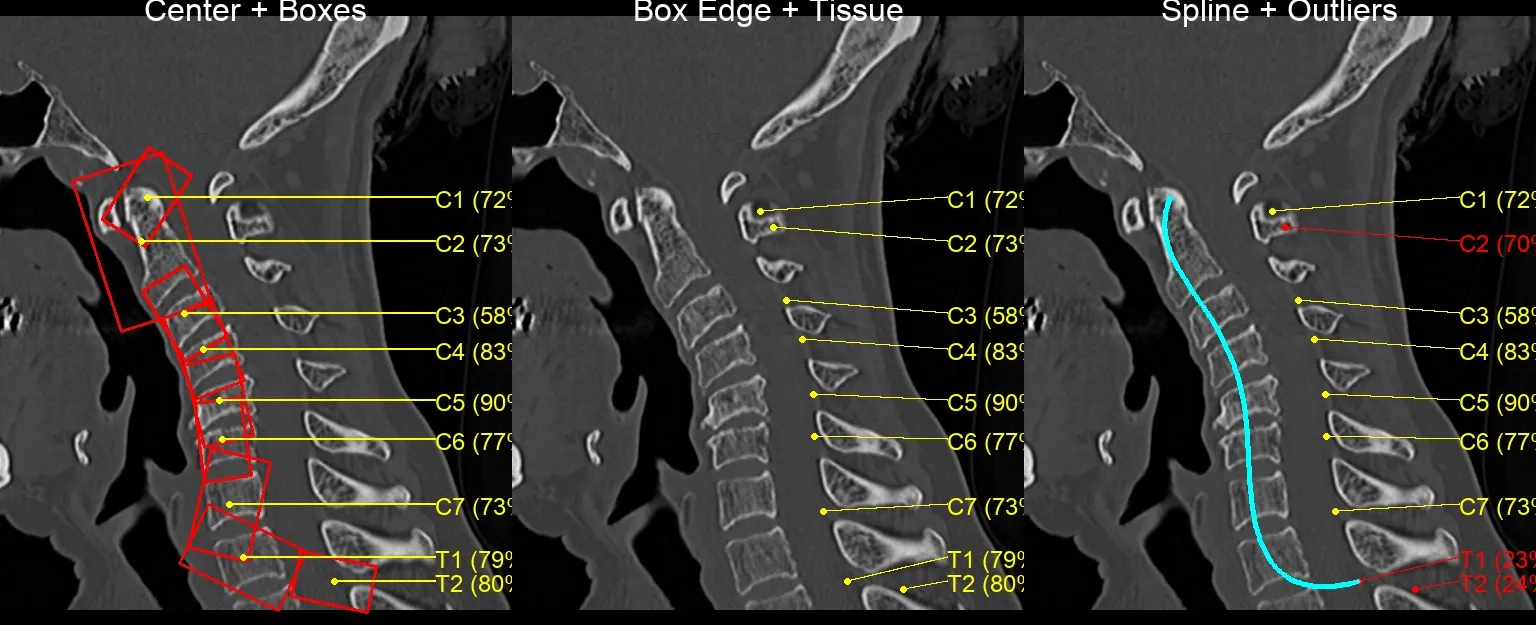
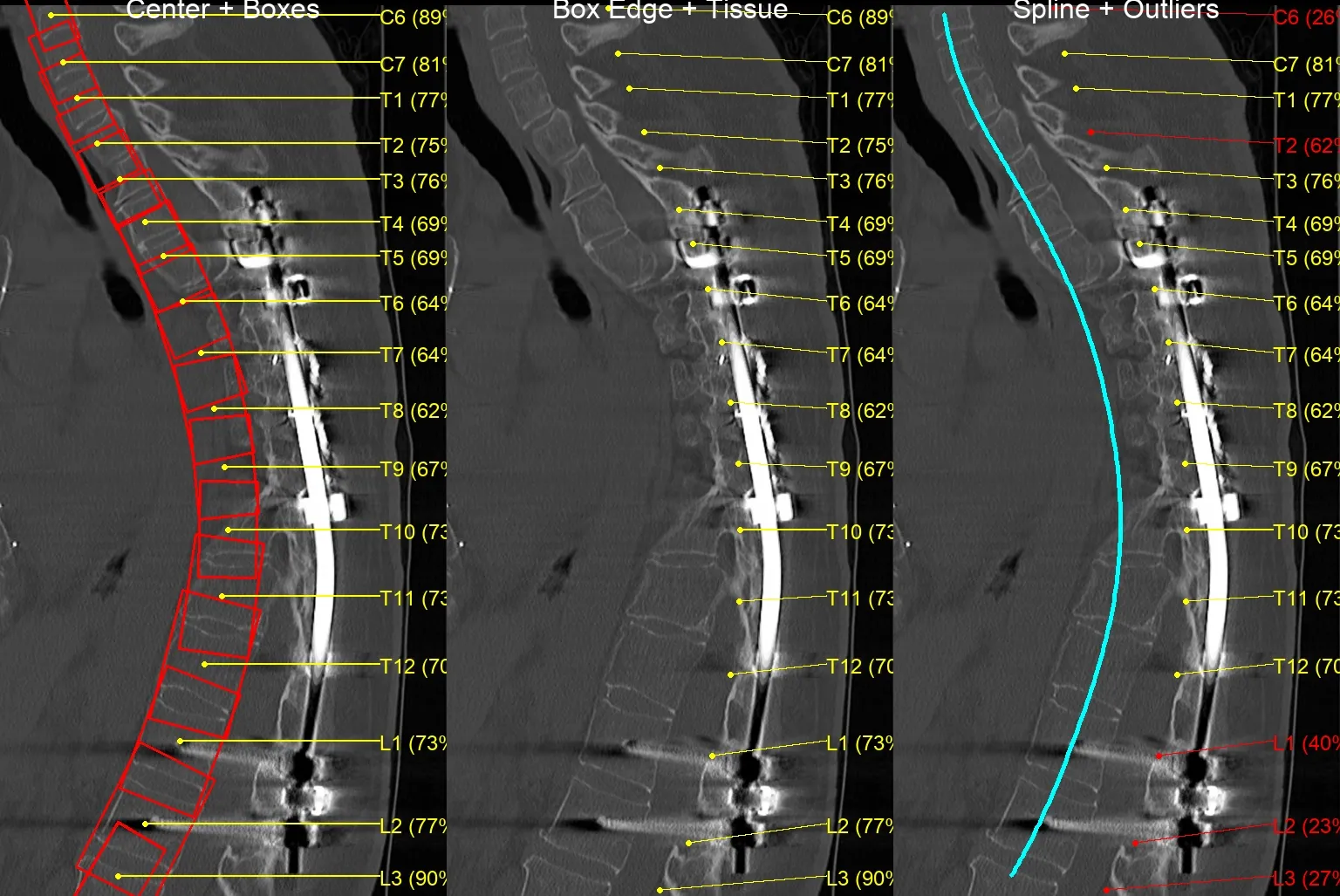
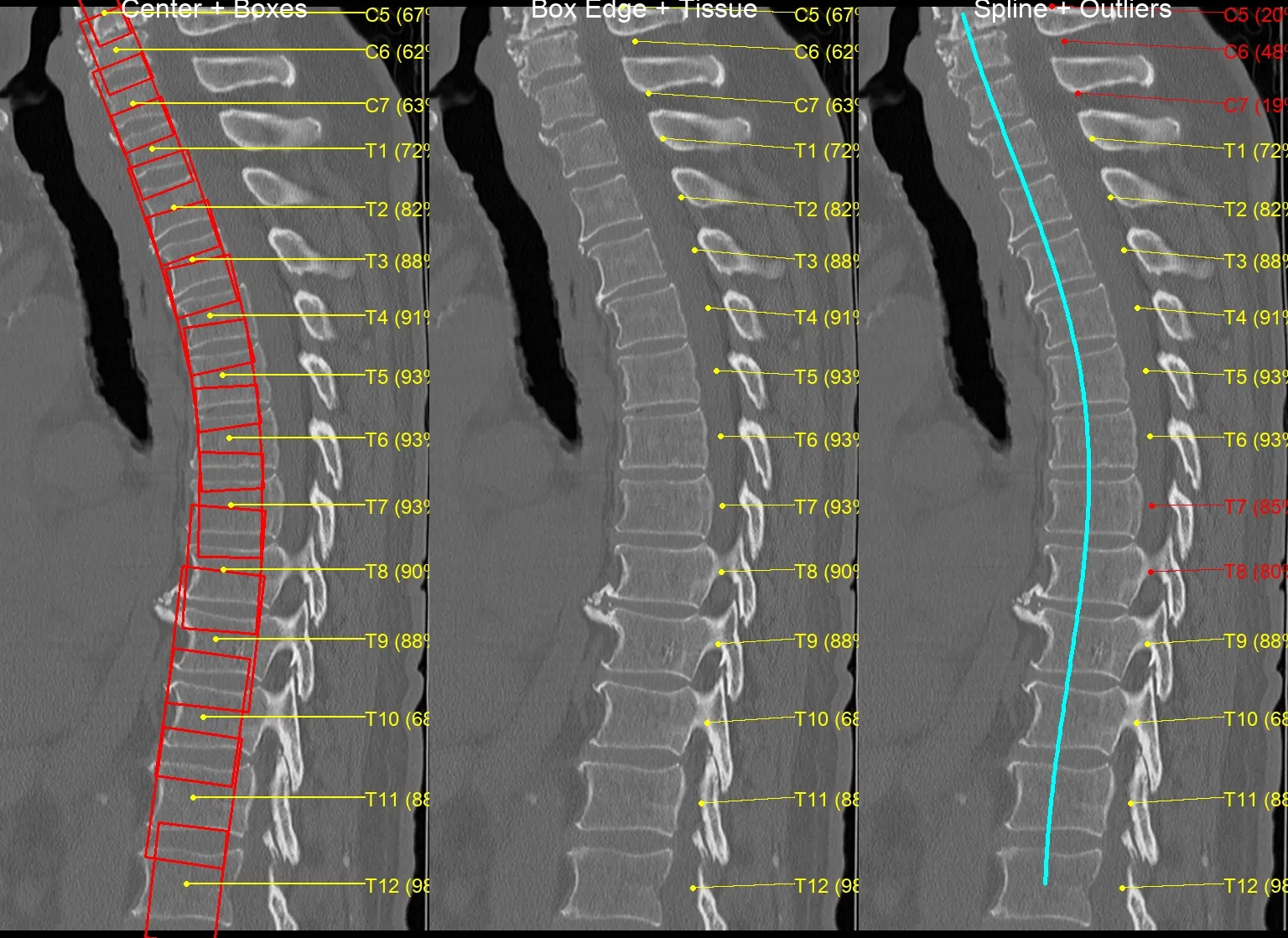
Vertebral labeling is slow, manual, and error-prone, and a PACS viewer has no native way to show an AI overlay. A useful system has to do more than segment — it has to put correct, named labels (T5, L4–L5) where the radiologist is already looking, inside the viewer they already use.
Architecture
A four-phase pipeline: DICOM → NIfTI conversion, reorientation and 1 mm isotropic resampling, two-step nnU-Net inference, then JSON generation with previews.
- Step 1 (coarse): a single-channel nnU-Net produces a whole-spine segmentation — disc types, vertebrae, sacrum, canal, cord — cleaned with largest-connected-component extraction.
- Step 2 (refined): a two-channel model takes the original scan plus the Step-1 labels, crops to the spine bounding box, and resolves vertebra subtypes.
- Iterative labeling: raw outputs are generic types; a spatial-reasoning pass anchors on landmark discs (C2–C3, C7–T1, T12–L1, L5–S1) and interpolates definitive anatomical labels along the column.
- Confidence scoring: a weighted blend of mean / p95 / high-confidence-ratio over the softmax, resampled to preserve probability accuracy.
Output is rendered as DICOM GSPS so labels, boxes, and arrows appear natively in the MedDream viewer — no separate tool.
Results
3–5 minutes per study, 90–95% radiologist-validated accuracy across 100+ test cases, packaged as CUDA (20.6 GB) and Apple-Silicon Docker containers behind a single POST /segment Flask endpoint. The CTO demonstrated it at the aycan booth at RSNA 2025, the world’s largest radiology conference.
Impact
Radiologists get named spine labels inside their existing reading workflow — the gap between a research segmentation model and a clinically usable overlay, closed end to end.